Dining chair and table fit: a measuring worksheet for Riyadh buyers
Check chair arms, table undersides, leg spacing and room movement before buying. Use a practical measuring brief for your Riyadh furniture enquiry.
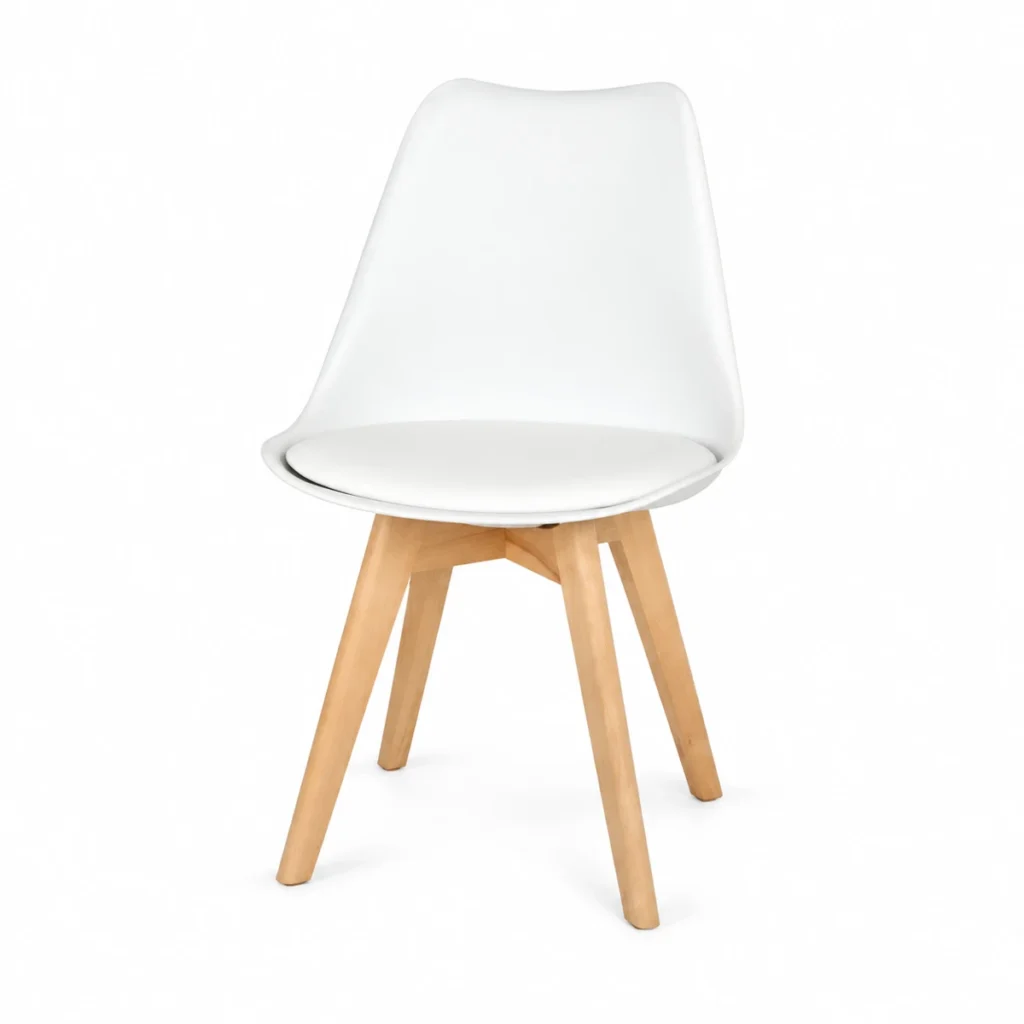
Image: AI-modified catalogue reference of a white dining chair; not a completed room or proof of dimensions.
A dining chair can match a table’s colour and still be awkward to use. Its arms may catch under the table, the legs may compete for the same floor space, or the room may become difficult to move through once people sit down. Before ordering separate chairs and a table, compare the actual pieces as a pair.
This worksheet helps you prepare a furniture enquiry. It does not certify comfort, access or suitability for a particular user. Final dimensions and the proposed combination need confirmation before purchase.
Measure the underside, not just the tabletop
Record the height from the floor to the top of the table, then separately measure the lowest obstruction underneath it. A deep apron, drawer or support rail can leave less room than the tabletop height suggests. Take measurements where a person will actually sit, including at the ends.
For the chair, request the seat height and the height of its arms, if present. Ask how a padded seat changes when occupied; do not assume an unoccupied cushion measurement describes the seated position. Compare the arm height against the point it must pass under when the chair is pushed in.
The vertical space above the seat depends on the actual table underside and the seat. Subtracting the seat height from the tabletop height alone can miss an apron. Use that comparison to identify a question for the supplier, rather than treating one arithmetic result as a comfort guarantee.
Check the usable span between table supports
The table’s overall length is not necessarily the space available to chair legs and arms. Measure the clear span between table legs or supports at the positions you plan to use. Check both the tucked-in position and the position needed for sitting down.
For each side, compare the combined actual chair widths with the space between supports. Then allow for the gaps and end clearances you intend to use. A general seat-count label does not establish whether your selected chairs fit: wide arms, splayed legs and a pedestal base can each change the arrangement.
Test the room with the chairs pulled out
Mark the table footprint on the floor with removable tape. Add the chair footprints and test the movement needed to pull them out. Include doors, cabinets and the route people use through the room. For an extending table, check both the everyday layout and the extended layout.
A plan that works with all chairs pushed in may fail during a meal. Check the intended users and any access needs directly. For a public or commercial setting, ask the project team to confirm applicable access and layout requirements; this household measuring worksheet is not a compliance assessment.
Use this brief when requesting a quotation
- Room, intended use and number of regular users.
- Table reference, overall dimensions, top height and lowest underside height.
- Clear spans between supports, with photographs of the base and apron.
- Chair reference, overall width and depth, seat height and arm height.
- Room layout with doors, cabinets and the proposed pull-out positions.
- Everyday and extended arrangements, if the table extends.
- Finish preferences, delivery location and access restrictions.
- Questions still awaiting a supplier measurement or physical fit check.
Keep the same units throughout. Label your own preliminary measurements clearly, and ask which dimensions the supplier has verified. A photograph without a scale is useful for understanding the shape, but it should not be used as proof of a product’s dimensions.
Compare the proposed combination before the price
When reviewing offers, confirm the exact chair and table references, quantities, finishes and dimensions. Ask whether the chairs shown are the actual proposed model. Check delivery and any assembly responsibilities in writing. A cheaper quotation for a different size or model is a different combination, not a like-for-like saving.
Browse the existing dining-chair collection, discuss a furniture supply enquiry, or ask about custom furniture requirements. Share your references and worksheet with TMF’s Riyadh team. Materials, dimensions, availability, delivery scope and prices are confirmed in the quotation.
Discuss your chair and table requirements or call +966582428765.
Make the ideas work for your space.
Share photographs, measurements and the furniture or interior details you have in mind. We’ll discuss suitable options and confirm your quotation.
Discuss your requirements →A few useful answers.
Will a chair fit if its arms are lower than the tabletop?
Not necessarily. Check the lowest obstruction beneath the table, the path of the arms and the position of the table supports.
Does a table labelled for six people fit any six chairs?
No. Compare the actual chair widths and leg positions with the usable spans, then test the layout with the chairs pulled out.
Can a reference photo replace measurements?
No. Use it to explain the look and construction, then obtain the dimensions of the actual proposed pieces.